One Revenue Question, Three Answers: Why AI Needs a Semantic Layer
ARR, bookings or revenue? One SaaS deal has three correct answers. Why your AI reports the wrong one, and how a semantic layer fixes it for good.
On this page 7 sections
TL;DR
- One $240K deal is $120K ARR, $240K bookings and $60K revenue. All three are right.
- AI plugged straight into your systems grabs whichever number it finds.
- A semantic layer, your company's official dictionary for numbers, gives every metric one definition, one owner and one source.
- Test definitions before launch. If the AI can't verify a number, it says so.
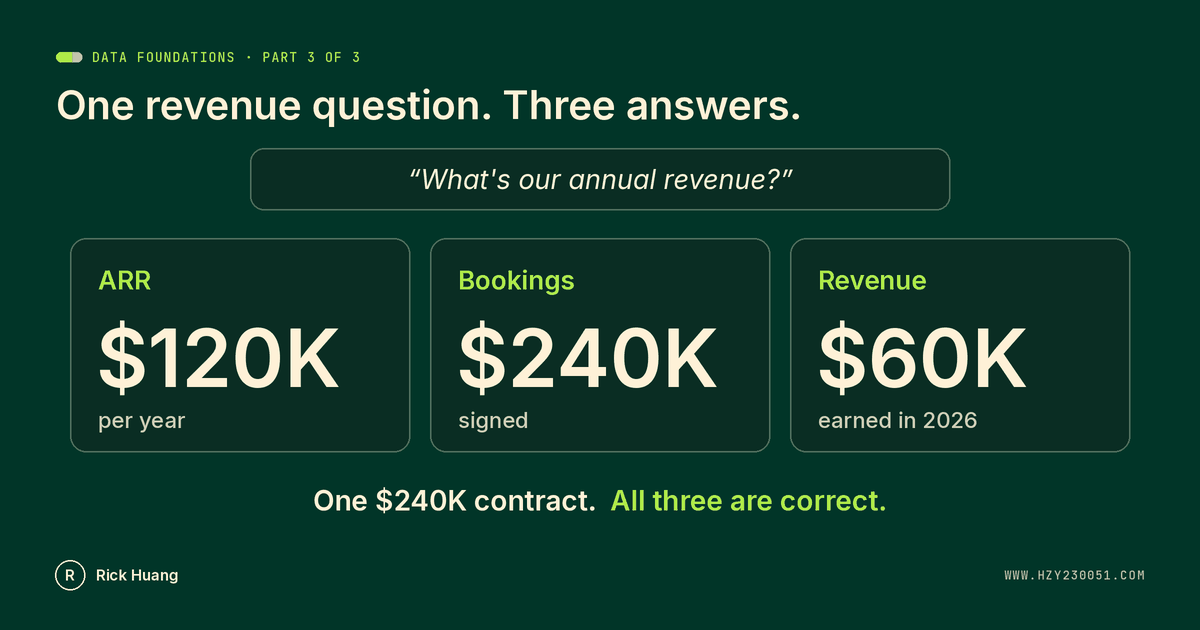
The CEO asks the company’s new AI assistant one question before the board meeting: “What’s our annual revenue?” It answers $240,000. The sales dashboard says $120,000. The CFO’s report says $60,000. Nobody made a mistake, and that is the problem.
Every company that puts AI on top of its numbers hits this moment. The AI isn’t bad at math. It just doesn’t know which “revenue” your company means, and nobody wrote it down in a place it can read.
This is Part 3 of my Data Foundations for Enterprise AI series. Part 1 got the data in one place. Part 2 made sure it’s correct. This part makes sure the AI reports the right number, and can show why.
ARR vs. Bookings vs. Revenue: Three Right Answers
Take one simple SaaS deal: a customer signs for $240,000 over 24 months, starting July 1.
- ARR (annual recurring revenue) is $120,000. It’s $10,000 a month, times 12. Sales and investors use it to size the business: what the customer base is worth per year if nothing changes.
- Bookings are $240,000. That’s the full contract value the day it’s signed. It measures how much the sales team sold.
- Recognized revenue this year is $60,000. Under the accounting rules (ASC 606 in the US), you earn subscription revenue as you deliver it: six months, July through December, at $10,000 a month. This is the number in the financial statements.
Try a different start date and watch which number moves:
One $240,000 contract, three correct numbers
24 months at $10,000 a month, delivered evenly, calendar fiscal year
- 01 · SalesARR$120,000Recurring value, annualized
- 02 · FinanceBookings$240,000Total contract signed
- 03 · FinanceRevenue recognized in 2026$60,000Jul–Dec, 6 of 24 months
recognized in 2026recognized later
Next year’s forecast is a fourth number, shaped by renewals, churn and the rest of the customers. None of these is wrong. They answer different questions, and the person asking rarely says which one they mean.
Why Connecting AI to More Systems Makes It Worse
The usual first step is to connect the AI to the systems where the numbers live: Salesforce for sales, NetSuite for finance. Now ask it about revenue twice.
Connectors return data, not definitions
AI + Salesforce
reads the CRM ARR field
$120K
reported as “revenue”
AI + NetSuite
totals signed contracts
$240K
reported as “revenue”
Same question different field, period or rule.
One answer reads the ARR field in the CRM. The other adds up signed contracts in the ERP. Both get labeled “revenue,” both come back with total confidence, and neither says what it actually measured.
A connector hands over whatever a system stores. It can’t decide which number the meeting needs. More connectors just mean more ways to be confidently wrong.
The Fix: One Official Definition for Every Number
A semantic layer is your company’s official dictionary for numbers, enforced by software. Each metric gets an ID card: what it means, how it’s calculated, which data it comes from, who owns it, and when to use it.
Approved metric · illustrative
active_arr
- Definition
- Annualized recurring value of active subscriptions; no one-time fees.
- Calculation
- Monthly recurring value × 12Flat subscriptions; use dated schedules for ramps
- Source and lineage
gold.subscription_contractsCRM → certified table → metric- Owner and use
- RevOps, approved by FinanceUse for ARR, not bookings
- Counting rule and context
- Each active subscription counted once · as-of date · version · freshness · allowed filters
The rule that makes it work: the AI never gets to improvise. It doesn’t search the database for a column that looks right. It looks up an approved metric, reads the definition and asks for that metric by name. Access rules and approved data sources are enforced by the system, not by asking the AI nicely in a prompt.
The only approved path for AI reporting
- 01Certified dataclean, tested tables
- 02Metric contractformula and owner
- 03Query servicedates and access
- 04Answerthe value and why
The AI requests an approved metric. It never writes its own warehouse query.
When the question is ambiguous, a well-built assistant asks before it answers, then shows its work:
What a verified answer looks like
- UserWhat's our annual revenue?
- AssistantARR, bookings or recognized revenue?
- UserARR, as of December 31.
- Tool call
query_metric("active_arr", as_of="2026-12-31") - Answer$120K ARR · $10K monthly recurring value × 12Certified data · owner RevOps · as of Dec 31, 2026 · metric v1.2
A good answer carries the number and what it means: which metric, which date, which source, who owns it. That’s what lets a CFO trust it, or challenge it.
How It Works Under the Hood
Skip this section if you’re not on the data team.
You don’t need a new platform to start. In practice, a semantic layer is three pieces:
- Definitions stored like code. Each metric is a short text file in version control, so every change is reviewed, approved and reversible. Tools like dbt’s semantic layer (MetricFlow) use this format.
- Definitions that read only checked data. Metrics point at the tested, certified tables from Part 2, never at raw system exports.
- One door for the AI. The assistant gets a single tool, something like
query_metric(metric, date), connected through MCP (the standard way AI assistants plug into business software). It can only request metrics on the approved list, so it can’t inventtotal_revenue_v2.
Show what a metric definition looks like
semantic_models:
  - name: subscriptions
    model: ref('subscription_contracts')   # certified table from Part 2
    measures:
      - name: arr_usd
        expr: monthly_recurring_value_usd * 12
        agg: sum

metrics:
  - name: active_arr
    label: ARR (active subscriptions)
    description: >
      Annualized recurring value of active subscriptions, excluding
      one-time fees. Use for ARR questions, not bookings or revenue.
    type: simple
    type_params:
      measure: arr_usd
    meta:
      owner: revops
      approved_by: finance
      certified: true
The description is written for people and AI alike. In my experience, rewriting vague descriptions (“net revenue, see finance wiki”) into plain statements of what’s included and excluded fixes more wrong answers than any model upgrade. I went deeper on the tool design and a 40-question test in the semantic layer is the API for AI.
Two Checkpoints That Stop a Wrong Number
Think of these as the financial controls for AI reporting.
Before a definition goes live: automated tests check that it reads certified data, counts each subscription once, calculates correctly and matches a few agreed examples, like the $240,000 deal above. Any change in meaning needs sign-off from the business owner. If a check fails, the change doesn’t ship.
Before the AI answers: it confirms it picked the right metric and dates, and that the result came back complete, current and permitted for this user. If the question is unclear, it asks. If the evidence is missing, it says “I can’t verify that” instead of guessing.
Two places to stop a wrong answer
1 · Before release
- Certified sourcetested tables only
- Automated testscounts, math, agreed examples
- Owner sign-offon any change in meaning
- Publish
✕ Any check fails → block the deployment
2 · Before the answer
- Right metricand the right dates
- Tool resultpermissions, freshness
- Verified?
- Answer, with sources
↺ Unclear → ask first · Unverified → “I can't verify that.”
AI is genuinely useful here: it can draft definitions, tests and catalog descriptions in minutes. It cannot approve its own work. A named person signs off on what each number means.
Build or Buy?
A small team can cover the basics with open-source MetricFlow, definitions in version control, automated tests and an AI-assisted catalog. The software is free; running it isn’t. Someone still owns the query service, access controls, monitoring and support.
Managed platforms such as dbt Cloud and Atlan add ready-made interfaces, integrations, lineage and governance. At scale they can pay for themselves. Either way, compare 12 months of total cost of ownership, not a subscription fee against zero.
Two ways to run the same discipline
Build the core
MetricFlow + CI
Open-source definitions in git. You run the query service, access, monitoring and support.
Buy the platform
dbt Cloud + Atlan
Managed interfaces, integrations, lineage and broader governance, for a subscription.
Compare 12 months of total ownership, not a subscription against zero.
Where to Start
- List the ten numbers leadership asks about most. Revenue, ARR, bookings, churn, gross margin. That list is your first metric catalog.
- Give each one a definition and an owner. One paragraph, one name. Settle the arguments now, not in the board meeting.
- Route the AI through those definitions only. Anything not on the list gets an honest “we don’t have a definition for that yet,” and that request becomes your backlog.
The Full Series
Part 1 made the data available. Part 2 made it reliable. Part 3 gives every number one meaning that everyone, including the AI, can check.
AI will keep getting smarter. It still won’t know what your company means by revenue until someone decides and writes it down.
Found this interesting? Share