Less Is More: Cut the Data Catalog, Keep Its Job
Data catalogs like Atlan and Alation were built so people could find and trust data. AI changed who is asking. Cut the copy, keep the job it did.
On this page 6 sections
TL;DR
- Catalogs like Atlan and Alation were built so people could find and trust data. AI now reads the source directly.
- Most of what a catalog shows is metadata copied from systems that already have it: your transformation code, semantic layer and monitoring.
- The governance workflow on top assumed a team of data stewards most companies never hired.
- Cut the tool, not the job. AI needs trusted definitions more than people ever did.
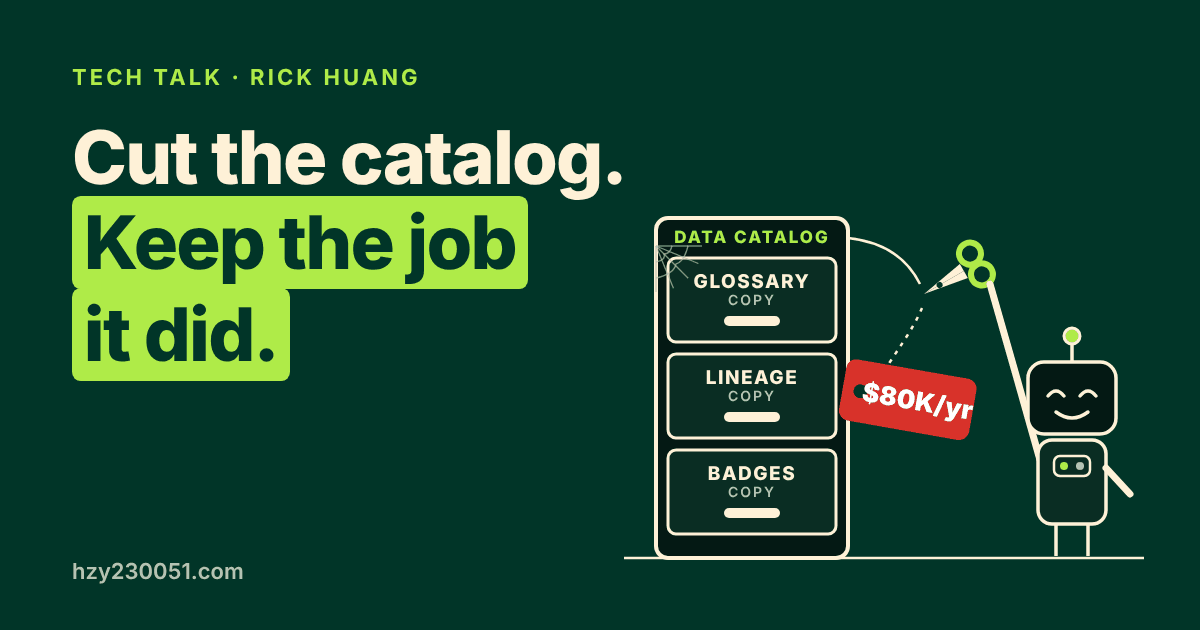
I just took a data catalog out of a company’s data stack. About $80,000 a year, gone.
And I’m not the only one. Several data leaders I’ve talked to this fall are lining up the same move.
Never used a data catalog? Think of it as a search engine plus a dictionary for a company’s data. Paying for one? Stick around. You might be paying for a mirror.
What Catalogs Were Built For
Ten years ago, finding the right data at a big company was like hunting for one book in a library with no index.
Say you wanted “active customers by region.” The warehouse, the central database where a company’s analytics data lives, had dozens of tables with “customer” in the name. Which one was right? Did “active” mean logged in, or paying? You’d lose a day asking around.
Data catalogs like Atlan and Alation fixed that. They connect to the warehouse, read its metadata, the data about your data (table names, columns, who queries what), and pull it into one place where you can:
- Search every table, column and dashboard
- Define business terms in a shared glossary, like “active customer” or “net revenue”
- Trace lineage: which source system and which processing step produced a number
- Certify trusted tables with a badge, and name an owner
- Run governance: data stewards, access approvals, audit trails
Real problem. Real fix. Especially at banks, where an auditor can ask you to prove where any number came from.
Then AI Showed Up
Here’s the shift: the one looking for data often isn’t a person anymore. It’s an AI assistant. And it doesn’t need a search box.
Your sales ops lead asks, “Where do we track pipeline by segment?” The assistant reads the warehouse layout and the code that builds each table, and answers in one sentence. Through MCP, an open standard for plugging AI into company systems, it can look things up the way a person would, only faster.
Meanwhile, look at where a catalog’s content actually comes from:
- Definitions live in the transformation code, the SQL in tools like dbt that turns raw data into clean tables, and in the semantic layer, where each metric like ARR or churn is defined once and reused everywhere.
- Lineage is generated by those same tools. dbt already knows which table feeds which, down to the column.
- Quality badges come from the tests and monitoring your data team already runs: is the data fresh, are there duplicates, do the totals reconcile.
So most of a catalog is a mirror: it copies metadata from systems that already have it. And a mirror has to stay in sync. When it drifts, you end up with two definitions of “revenue” and nobody knows which one is right.
The Part Nobody Used
So what did the catalog add on its own? The governance workflow: stewards who curate definitions, approval queues for data access, review cycles, comment threads.
That workflow assumes a governance team. A data steward in every department. Business owners who sign off on definitions every quarter.
Large regulated banks staff that. Most companies never hired it.
So the queues sit empty, the glossary goes stale, and you keep paying for a governance plan nobody staffed.
Wait. Don’t Throw Out the Job.
Here’s where people get it wrong. Cutting the tool is not cutting the function.
When a person isn’t sure about a number, they walk over and ask. An AI agent doesn’t. It picks the table that looks closest, writes the query, and answers with total confidence.
Bookings (contracts signed) and recognized revenue (what accounting counts this quarter) can be millions apart. Your CFO won’t care which table the AI picked.
That’s why the metadata matters more now: a clear definition, a named owner, a certified version, a sensitivity tag that marks what’s private. That context is what keeps an AI’s answer grounded. It matters more now, not less.
The catalog vendors see it too. Some now pitch themselves as the “context layer for AI.” Right need. You probably don’t need another product to meet it.
Build Your Own, Right Where the Work Happens
AI makes it cheap to build exactly the catalog your business needs, inside the stack you already run:
- Write definitions next to the logic. Descriptions, owners and metric definitions live in the same files as the dbt models and the semantic layer. One copy, reviewed in the same pull request as the code change.
- Make “certified” an automatic check. Before a table ships, a CI check (the automated tests that run on every code change) confirms it has an owner, a description, tests, a sensitivity tag and a schema contract, a promise that its columns won’t change without warning. Miss one, and it doesn’t merge.
- Let AI draft, let people approve. AI writes the first draft of the documentation from the code. The owner reviews it in minutes instead of writing it from scratch.
- One source for people and agents. Dashboards, analysts and AI agents all query the same certified definitions through the semantic layer. Nobody works off a stale mirror.
- Shape it around your business. GTM cares about pipeline stages and attribution rules. Finance cares about revenue recognition. Ops cares about fulfillment and SLAs. A vendor’s generic template doesn’t.
The 5-Minute Test
Still need a standalone catalog? Maybe. Heavily regulated, thousands of data sources across many platforms, real stewards doing real work: keep it.
Everyone else, try this:
- List everything your catalog shows.
- Next to each line, write the system where the original lives.
- If almost every line points somewhere else, you’re paying for a mirror.
Fewer tools. Same answers. One copy of the truth.
Less is more. So what’s in your catalog that doesn’t live anywhere else? Tell me.
Found this interesting? Share