Why Your AI Video Budget Isn’t Turning Into Ads
AI tools made video drafts cheap. Ads your brand will approve are as hard as ever, and every rejected try is billed again, often at a markup on the model.
On this page 6 sections
TL;DR
- Making an AI video draft got cheap. Making one your brand team will approve didn't.
- You pay for every rejected try, so the real price is per approved ad, not per video.
- Runway and ElevenLabs both resell Seedance, a video model from ByteDance, TikTok's parent company. For the 30-second ad in this post, the model itself cost $31. The Runway bill was $288.
- The fix is your brand rules, written as checks that run on every video before a person looks.
This week I met creative and marketing leads at several big companies. Same story everywhere: seven-figure budgets for AI video, piles of rejected renders, almost nothing in a live campaign.
The spend is real. JPMorgan Chase, which signed a five-year deal for AI-written ads back in 2019, expects to spend roughly $19.8B on technology this year. Expedia spent $2.12B on direct sales and marketing last quarter and told investors some AI bets aren’t converting yet. MIT NANDA found 95% of organizations see no measurable return on generative AI.
A Draft Is Not an Ad
Runway and ElevenLabs lowered the barrier to a draft. They did nothing for the barrier to an ad your brand will sign off on.
An approved ad is the exact bottle shape, an approved claim, a logo that doesn’t warp in frame 47. These tools give you a prompt box and sliders. What you need is enforcement: hard brand rules, approved reference images, and checks that catch a broken video before a person does.
Even the biggest brands can’t brute-force it. Coca-Cola’s 2025 Christmas ad took a five-person team over 70,000 clips in 30 days and still shipped a fireplace with no chimney. J.Crew’s AI campaign ran a model with a backward-bending foot.
And “wrong” differs everywhere: a melted label for a drinks brand, an invented rate for a bank, an illegal claim for pharma. A general-purpose tool can’t know your rules.
You Pay per Try, Not per Ad
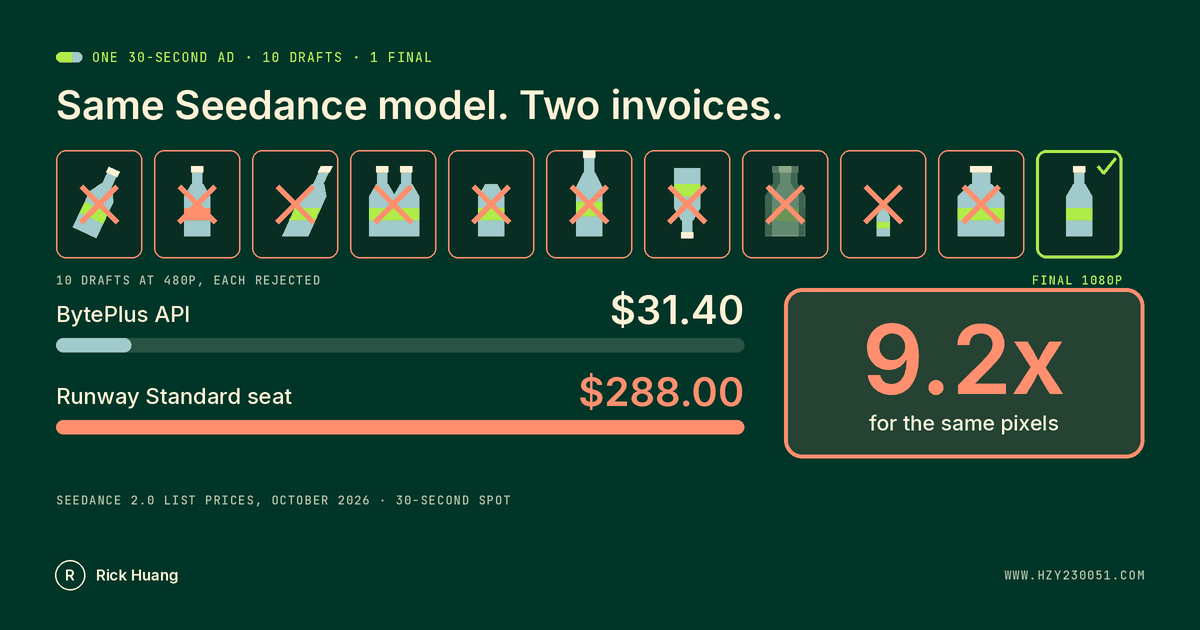
Here’s the number to watch. Take the 30-second ad I price below: ten drafts rejected, one approved. You paid for eleven videos to get one ad, plus the hours your team spent saying no to the other ten.
Without automatic checks, every rejection costs a human and a re-render
Tools like Runway
- Prompt + generate
- Human review
- On brand?
- Ship
✕ No → tweak the prompt, regenerate, pay again
Your own checks
- Brand ruleschecks + references
- Generate
- Passes checks?
- Sign off + ship
↺ No → automatic retry, no human time
Every trip around the red loop costs credits and a reviewer’s afternoon. The license fee doesn’t kill the budget. Paying again for every redo does. So stop tracking cost per video. Track cost per approved ad.
The Model Inside Runway Is ByteDance’s
Most marketers know Runway. Fewer know where the video actually comes from.
Seedance videos carry a hidden label saying which model made them. The standard is called C2PA, and Seedance now ships with it; think of it as a nutrition label for content. On the files I’ve inspected from these tools, the label traces to BytePlus, the business arm of ByteDance, the company behind TikTok. BytePlus sells Seedance, ByteDance’s video model, directly.
Runway does list Seedance as a third-party model, and ElevenLabs offers it too. But nobody in the budget meeting reads the dropdown. They’re paying a reseller’s markup on someone else’s model, and it’s worst on the cheap drafts they make the most of.
For that 30-second ad, the Seedance part costs $31.40 bought from BytePlus. On a Runway Standard seat, the same eleven videos cost $288, 9.2 times more.
Runway’s answer is that you’re paying for the editing layer. For some teams that’s worth it. For brand-critical ads, it isn’t what’s holding you back. It stacks wrapper on wrapper, crowds the page with panels, and an ordinary creative can’t turn a few quick instructions into a complete, repeatable workflow. The automation stays on the spec sheet.
It’s the car dealership all over again. You came in for the engine. Then the finance office slides the options sheet across the desk: a $6,000 protective wrap, $3,500 air suspension on a family SUV, a $5,000 “market adjustment.” None of it makes the car faster, and some of it costs you again every year.
Same engine, loaded trim: where a 9.2x markup goes
On the sticker ↔ on your Runway invoice
- Engine↔ Seedance 2.0 · the part that makes the video, same in every trimstandard
- Looks great, drives the same
- Full-body protective wrap↔ The editing layer · a pricey wrapper around the same model+$6,000
- Panoramic sunroof↔ Workflows + Agent · stunning in the demo, opened twice+$1,500
- Sounds like an upgrade, costs you later
- Air suspension, family SUV↔ Per-seat plans · the bill grows with every teammatelater: $1,500 a strut when one leaks+$3,500
- 22-inch wheels↔ Re-renders · every rejected draft is billed againlater: harsher ride, $400 tires+$2,500
- Pure markup
- Nitrogen tires, VIN etching↔ One-click extras · upscale, lip sync: sold cheaper everywhere+$1,500
- "Market adjustment"↔ Reseller margin on Seedance · the same model, marked up+$5,000
Options you pay for+$20,000
The real invoice: the post's 30-second ad on a Runway Standard seat
Seedance itself $31.40 (11%)everything else $256.60
- Engine= samesame Seedance model
- 0–60= samesame pixels out
- Running cost↑ upseats and re-renders
What to Do This Quarter
- Track cost per approved ad, not cost per video. Count every try, including the rejected ones.
- Ask your vendor which model made your videos, and what that model costs bought direct.
- Write your brand rules down as a checklist: exact product shape, logo, colors, approved claims. That checklist, not the tool, is what gets ads approved.
- If AI video is a seven-figure line item, build the checks once. A small engineering team can do it inside your own workflow for $200–300K: every video checked against your rules and approved reference images, failures retried automatically before a person looks, and the model bought at the provider’s price. That’s instead of $1M a year on seats and re-renders.
Stop Buying the Interface
The interface was never the hard part. Getting every video on brand is.
Some will call this bias. It isn’t. AI is supposed to make work faster and cheaper, for a freelancer or a Fortune 500. A 9x markup on the same model is the exact opposite.
How I Priced It
For anyone who wants to check the math. The 30-second ad assumes ten 480p drafts and one 1080p final on a Runway Standard seat ($15 for 625 credits, 2.4 times the API rate).
Draft at 480p and Runway charges 5.4x the BytePlus price
Seedance 2.0, USD per second of output
BytePlus APIRunway APIRunway markup
How it's calculated. BytePlus: tokens = width × height × 24 fps × seconds ÷ 1,024, at $7.00 per million (480p, 720p) or $7.70 (1080p). Runway API: 36 credits/s at 480p or 720p, 40 at 1080p, $0.01 a credit. Markup = Runway ÷ BytePlus. On a Runway Standard seat ($15 for 625 credits), multiply Runway by 2.4.
Drafting at 480p feels thrifty. On Runway it's where you get fleeced hardest: a 480p second costs 90% of a 1080p one there, versus 18% on the BytePlus API.
Prices: Runway API, Runway plans, BytePlus token rates. Seedance 2.5 follows the same pattern: the 30-second test costs $48 direct, $80 on Runway’s API and $193 on a Standard seat.
Found this interesting? Share