Your AI Shouldn’t Need a Babysitter
DeepSeek’s Super-agent design says the limit on AI isn’t the model anymore. It’s my attention. How it works, and how I already run my week this way.
On this page 6 sections
TL;DR
- One task is limited by the model. Many tasks are limited by my attention.
- DeepSeek’s fix: one manager AI that sorts everything, many worker AIs that each do one job.
- It acts on triggers, not prompts, and stays quiet unless it has a fix ready.
- Faster and steadier in their tests, but it burns more tokens, and security is still open.
- I already work this way: I set goals and approve. Agents do the rest.
Confession: some days I have five AI chats open at once. One fixes a data model. One drafts a post. One chases a bill for my rentals. And I’m the one running between them, pasting context, checking who’s stuck.
By window four, I’m the bottleneck, not the AI.
So when DeepSeek’s Harness team published a design write-up called Super-agent today, I read it twice. It names my problem better than I could.
Quick term: the AI model is the brain. The “harness” is the body around it, the tools, notes and loop that let it actually do things. DeepSeek open-sourced theirs in August.
The Real Limit Is Me
Today every AI task lives in its own chat window. I open one, give instructions, wait, check, jump to the next. DeepSeek says most people can keep 3 to 5 going before they lose track. That’s my week, exactly.
Their key point: the AI’s skill limits how well one task gets done. My attention limits how many. The AI keeps getting smarter. My attention doesn’t.
One Manager AI, Many Worker AIs
Think of a busy restaurant. The host takes every order. Each cook makes one dish. Nobody asks the customer to walk into the kitchen.
Super-agent splits AI the same way:
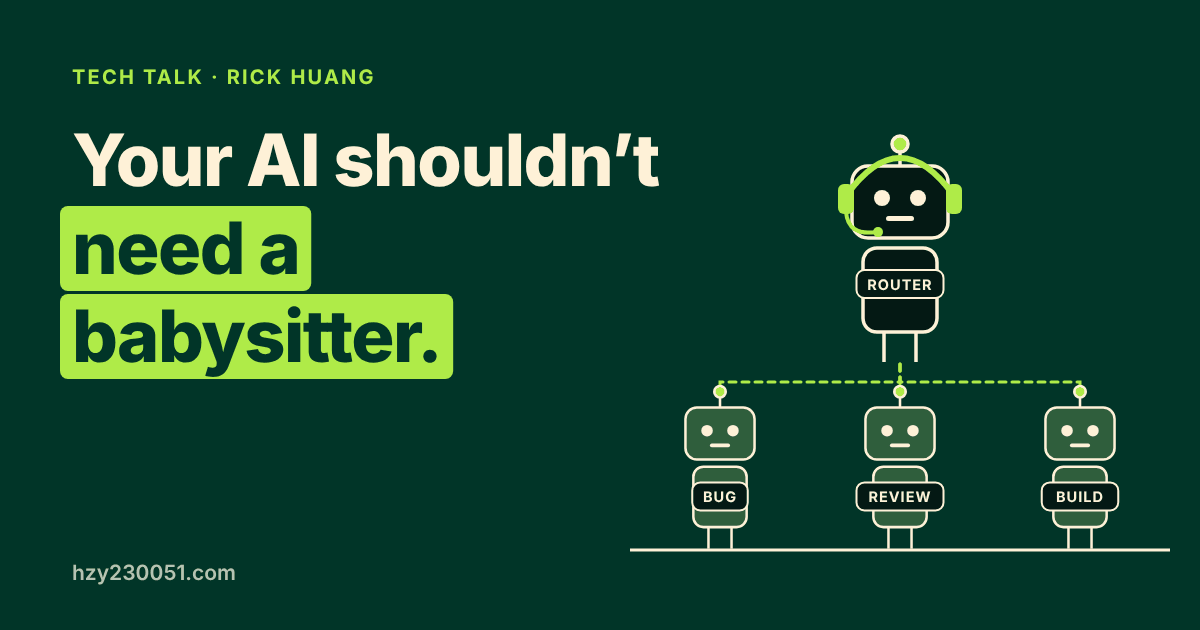
- The Router is the manager. Always on. It listens to team chats, GitHub and email, decides who does what, and keeps the big picture. It never does the work itself.
- The Workers do the jobs. Each gets its own notes and tools, does one thing, and reports back. The Router gives me one clean update.
It Acts Before I Ask
Most AI tools wait for me to type. A Super-agent reacts to triggers: a chat message, an email, a calendar invite, a failed test. Simple rules filter out the noise first, then the AI judges what’s left.
My favorite part: DeepSeek runs a rule on their own team called “quietly reproduce and fix.” Someone reports a bug in chat. The agent tries to recreate it in the background, and only speaks up if the bug is real and the fix is simple. In their demo, the fix landed while people were still discussing the bug.
“Nobody tagged it” doesn’t mean “it does whatever it wants.” I write the rules for when it may jump in.
Two more ideas I’d steal: slow jobs run in the background so I can still talk to it or say stop, and the thinking lives in the cloud, so the work keeps going when my laptop sleeps.
Faster, Steadier, Not Free
DeepSeek fed it about 300 fake messages, only 20 of them real work, and compared it with one chat that’s allowed to call helpers.
- Speed. A typical task took 12.4 minutes. Even the slowest 5% finished within 15.7. The single chat’s slowest 5% took 29.5.
- Why. With a neutral prompt, the single chat never handed off a job in five runs. Asking an AI nicely to split up work isn’t reliable. Building the split into the system is.
- Cost. It burns more tokens, the units AI usage is billed in. Without its shortcut for follow-ups, the manager reads about 37% more.
Fake messages, fake tools, so treat it as a first look, not a verdict.
How I Already Work This Way
I hit the five-window wall a while back, so I rebuilt my setup around one rule: I set goals, make the calls, and check the work. Agents do the rest.
My router is a Grok bot. It has a channel for each part of my life: rentals, travel, personal brand, life admin, side projects. Each has its own instructions. It filters what comes in, routes it, follows up, and preps things for me. A normal week:
- A utility bill lands for a rental. The agent splits it between tenants and drafts the payment requests. I glance, approve, send.
- Every morning. It writes my AI news brief and checks a log so it never repeats a story. I read it with coffee.
- A dbt data test fails. It reads the error, finds the broken model, and proposes a fix. I review it and merge or push back.
That last one is DeepSeek’s “quietly reproduce and fix,” for data pipelines. The biggest change wasn’t speed. I stopped typing instructions and started approving results.
What I’m Still Watching
- Security. An agent that reads outside messages all day and can reach my laptop is a big target. DeepSeek says it themselves: until that’s solved, keep it in a small, trusted circle.
- Memory. After weeks of work, pulling back the right history is still hard.
- Control. When an AI runs dozens of jobs, how do I see progress and decide what always needs my OK?
The best AI assistant won’t sit in a chat box waiting for me. It’ll act like a coworker who knows what to pick up when I haven’t asked.
So how many AI windows do you have open right now? Tell me.
Found this interesting? Share