Everyone has AI now. So why would anyone pick yours?
When one feature has a hundred look-alike products, the product stops being the reason people choose. A person they trust is.
On this page 3 sections
TL;DR
- AI made building so cheap that one feature now has a hundred products instead of two or three, with the same models, similar prices and equally clean design.
- Once products are interchangeable, people stop choosing on features and pick what someone they trust told them to try.
- Grok Bot, OpenAI’s dots and Meta’s Muse all give you a personal agent on its own cloud computer, and for everyday errands most people will use whichever one a friend swears by.
- AI can find leads and run campaigns, but while a human still makes the final call, real relationships close the deal, so that is where to invest next.
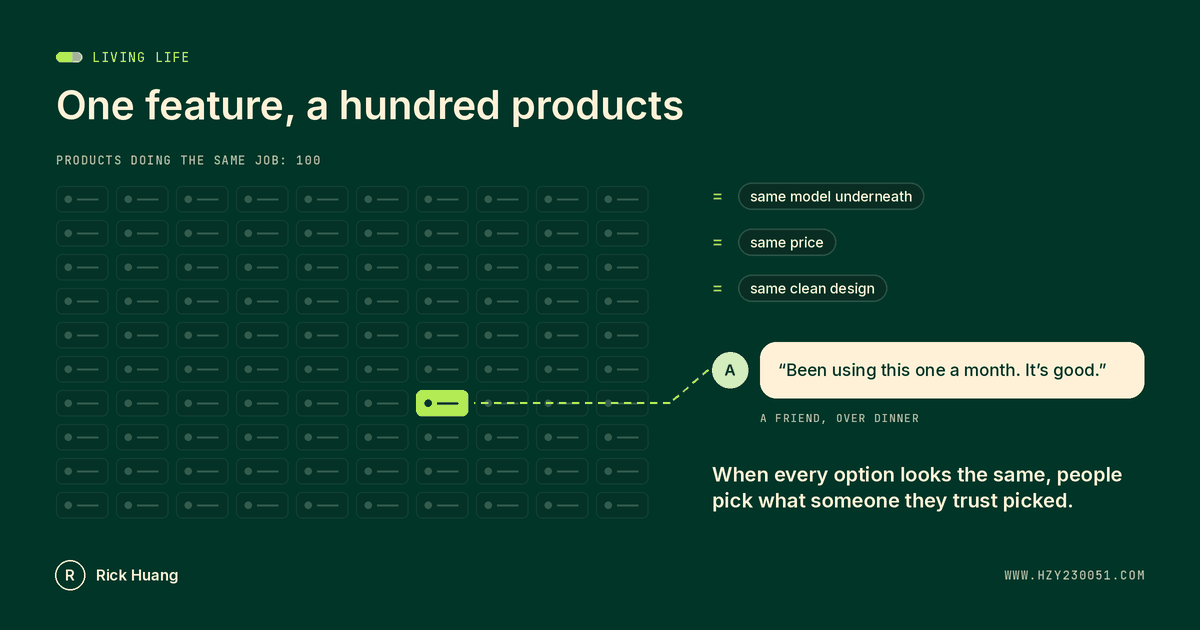
For most of the last ten years, building the thing was the hard part. If you managed to ship a decent product, you usually had two or three real competitors, and being good was often enough to get noticed.
AI changed that fast. A small team can now ship in a weekend what used to take a quarter. So one feature doesn’t have three products anymore. It has a hundred.
And they all kind of look the same. Same models underneath. Same feature list. Similar price. Same tasteful landing page with a gradient and a demo video.
Which leaves an awkward question for anyone building anything:
Why would someone use yours instead of the other ninety-nine?
A Real Example
Right now there are at least three big personal agents that live on their own cloud computer and run errands for you: xAI’s Grok Bot, OpenAI’s dots and Meta’s Muse. They book things, fill in forms, deal with email, and keep working after you close the app.
For the small stuff in my day, I honestly couldn’t tell you which one is better. They’re close enough. Say the price is the same too.
So how would I actually pick? A friend tells me, “I’ve been using Muse for a month, it’s good.” I try it. It works. I stay. No comparison table, no benchmark. And if nobody I knew had mentioned it, I probably never would have opened it.
Muse isn’t special here. Almost every crowded category ends up working this way once the products converge.
AI can reach people. It can’t make them trust you.
To be fair, AI makes sales and marketing better too. It finds leads you’d never have found, writes thousands of outreach emails, tunes ad spend, tracks every metric down to the hour. Use all of it.
But look at who’s on the other end. Until AI makes buying decisions by itself, a person still makes the final call. And when I’m that person, I’d rather deal with a human. Anyone who has escaped a support chatbot and finally reached someone who actually listens knows how big that gap is.
So when the products are a tie, the relationship breaks the tie. Who told you about it. Who picked up when you had a question. Who you’d feel bad letting down.
The Trap
Here’s a mistake I see a lot, and I’ve made it myself: feeling “AI-enabled” and assuming everything just got easier.
Building got easier. Getting chosen got harder, because everyone got the same tools on the same day.
That’s true whether you’re in manufacturing, retail or healthcare, whether you sell physical goods or software, AI or AI-generated content. The cheaper it gets to make the thing, the more the value moves to the part that’s still expensive: real relationships and real trust.
So that’s where I’m putting my effort next. Less cold outreach, more people who know me and would vouch for what I build. Coffee, calls, showing up, being useful before there’s anything to sell.
Your product might be one of a hundred. You aren’t.
If this landed, don’t post it everywhere. Send it to one person you’d vouch for.
Found this interesting? Share