Novelty is the highest-yield asset
The best returns I get are on time spent learning something new or going somewhere unfamiliar. Why routine makes the years disappear, and why reading and travel belong in the budget, not the leftovers.
On this page 5 sections
TL;DR
- Memory records change, not time. Routine days get compressed and thrown away while novel days keep their edges, which is why 2020 and 2021 feel like almost no time at all.
- Routine is efficient and quietly expensive: it makes you faster at what you already know and leaves very little behind in memory or in the toolkit.
- Reading and travel are the cheapest ways to buy novelty in bulk, and they compound with each other. Ten thousand books, ten thousand miles is a precise investment thesis.
- Treat them as line items rather than leftovers, and ask regularly: what did I do recently that I had never done before?
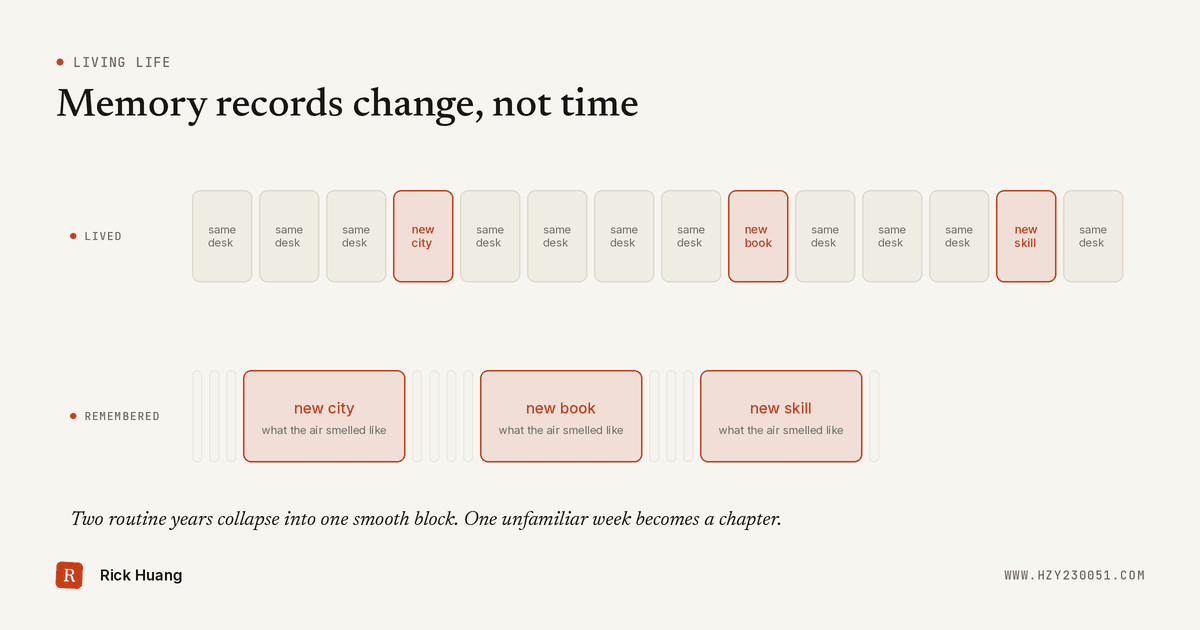
Ask me what I did in 2020 and 2021 and I have to think for a while. Not because nothing happened. A lot happened, to everyone. But for me those two years sit in my memory as one long, smooth block: the same desk, the same window, the same walk around the same few streets, the same video calls with slightly different faces in the little squares. They were long while I was living them. Looking back, they are almost no time at all.
Meanwhile I can still remember, in embarrassing detail, the first week in some unfamiliar place years ago: what the air smelled like, which sign I couldn’t read, what I ordered by pointing. A week that takes up more room in my head than two whole years.
That mismatch has been bothering me, in a good way. I think it says something about where time actually goes, and where I should be putting mine.
Why the years get shorter
There is an old, simple explanation for why time seems to speed up with age. When you are ten, one year is a tenth of your whole life. When you are forty, it is a fortieth. Each new year is a thinner slice of everything you’ve lived, so it feels smaller. I find this convincing as far as it goes, but it’s a little fatalistic. It suggests the years shrink no matter what you do, on a schedule, like depreciation.
The second explanation is more useful, because it leaves room to act. Memory doesn’t record time; it records change. A day that looks like the day before it gets compressed, filed under “the usual,” and mostly thrown away. A day with something new in it, a new place, a new problem, a new word, gets stored with its edges intact. When we look back and estimate how long a stretch of life was, we are really counting how many distinct memories we kept from it.
So routine has a strange double effect. While you’re in it, time drags, because nothing is pulling your attention forward. Afterward, it collapses, because there is nothing to remember. Novelty does the opposite. A trip flies by while you’re on it and then feels enormous in hindsight. The pandemic years were the cleanest experiment I’ll probably ever get on this: almost no novelty, and almost no memory to show for it.
Routine is efficient, and quietly expensive
I don’t want to be unfair to routine. I like routine. It’s how work gets done, how habits stick, how a household runs without a meeting every morning. Most of what I’m good at came from doing the same thing many times. Efficiency is real, and a life of constant novelty would be exhausting and probably unproductive.
But efficiency has a cost that doesn’t show up on any statement. Every year spent running the same loop is a year that leaves very little behind in memory, and very little new in the toolkit. Doing the same thing better makes you faster at what you already know. It rarely makes you someone who can see a problem from a different side. The skills I actually value most did not come from optimizing a familiar task. They came from being a beginner at something, a little lost, a little embarrassed, and slowly less so.
If you think of attention as capital, routine is a savings account: safe, steady, low yield. Novelty is the riskier asset, and it’s the one that compounds.
Ten thousand books, ten thousand miles
There is an old line every Chinese kid hears from adults: read ten thousand books, travel ten thousand miles. It usually arrives in the same breath as advice to drink more hot water, and for a long time I filed it in the same drawer. Now I think it is a fairly precise investment thesis.
Reading and travel are the two cheapest ways I know to buy novelty in bulk. A good book puts a whole new way of thinking into your head for the price of a lunch and a few evenings. Travel puts you somewhere your habits don’t work, where you have to pay attention again to how to buy a ticket, how people queue, what is rude and what isn’t. Both force the brain out of autopilot, and both leave memories with edges.
They also compound with each other. What you read changes what you notice when you go somewhere. What you see on the road changes which books feel alive when you come back. Ten thousand books without the road can turn into theory; ten thousand miles without the books can turn into sightseeing. The saying puts them in one sentence for a reason.
And there’s a third leg the saying leaves implicit: learning something with your hands, a new tool, a new skill, a new language, even badly. Another old saying covers it: live until old, learn until old. It sounds like a slogan on a classroom wall, and it is. It is also, as far as I can tell, the only reliable way to make an ordinary Tuesday memorable.
Line items, not leftovers
The practical conclusion I’ve come to is embarrassingly simple. Reading and travel can’t be what I do with whatever time and money are left over at the end, because nothing is ever left over. Work expands, errands expand, and “next year” is a very comfortable place to keep plans.
So I’ve started treating them the way I’d treat any investment I believe in: as line items. A reading budget I actually spend. Time off that’s planned for somewhere I haven’t been, not just for recovering. A small, deliberate habit of trying one genuinely new thing on a regular basis, whether that’s a skill, a cuisine, a neighborhood I’ve never walked, or a field I know nothing about.
Every so often I ask myself one question: what did I do recently that I had never done before? If the honest answer is “nothing,” that is a more useful warning than any calendar. It means the last few months are about to vanish the way 2020 did.
The yield
I don’t have a spreadsheet that proves novelty is the highest-yield asset. What I have is a memory that keeps its own books, and it is surprisingly clear about which years paid off. The ones with new places, new problems and new people in them are long and full. The ones without are thin, no matter how productive they looked at the time.
Money compounds if you leave it alone. Experience only compounds if you keep adding to it. If I’m wrong about all this, the worst case is that I read a lot of books and saw a lot of places, and I can live with that.
Found this useful? Pass it on