Five long bets on AI, data and financial infrastructure
Where I'm putting time and capital over the next decade, the signal I watch for each bet, and what would prove me wrong.
On this page 5 sections
TL;DR
- Agents eat workflows before they eat jobs: the model is becoming a commodity, and the harness around it (evals, permissions, audit trails) is not.
- The semantic layer becomes AI infrastructure, because a model has no idea what revenue means at your company until someone writes it down.
- Crypto rails turn into boring, regulated plumbing: custody, settlement, stablecoins and tokenized funds. Boring is the bull case.
- Energy and compute are the real bottleneck, and physical automation is slow until a robot-hour costs less than a wage, then inevitable.
- Each bet comes with the signal to watch and what would prove it wrong.
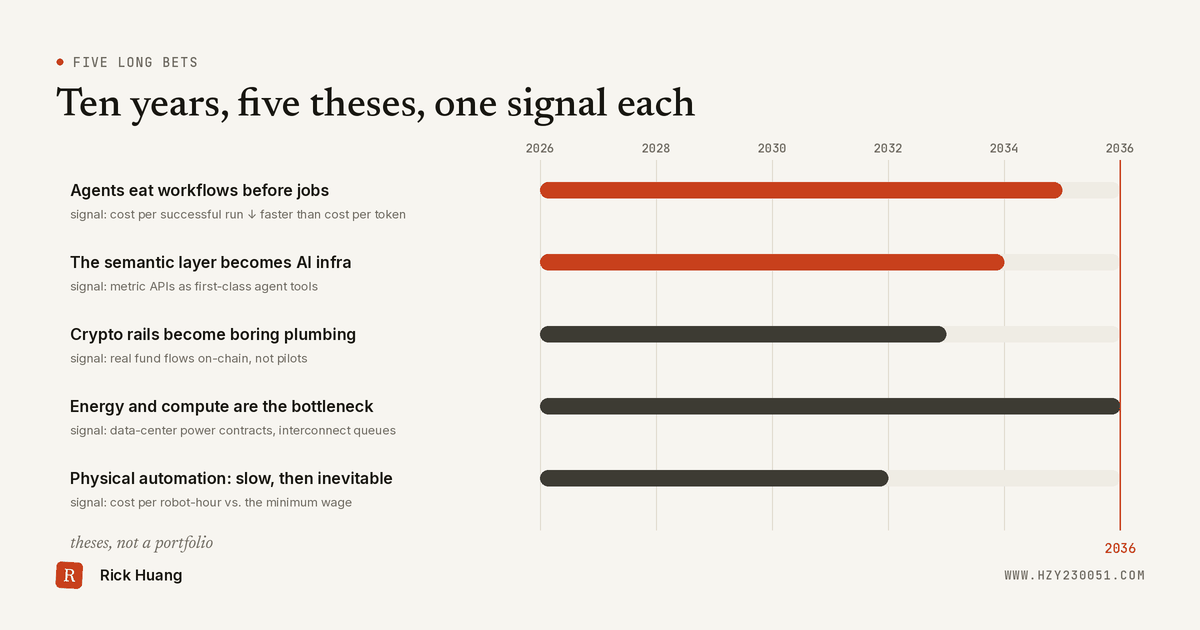
These are theses, not a portfolio. Each one is a bet I’m making with my time, my career and some of my money, written down so I can be held to it. For every bet: the claim, the signal I watch, and what would prove me wrong.
1. Agents eat workflows before they eat jobs
The near-term value is in harnesses, evals, permissions and audit trails that let a model safely operate inside an existing process. The model is becoming a commodity; the loop around it is not.
- Signal to watch: cost per successful agent run falling faster than cost per token.
- I’m wrong if: general models get reliable enough that the harness stops mattering.
2. The semantic layer becomes AI infrastructure
LLMs are fluent, but they have no idea what “revenue” means at your company. Governed metric definitions, data contracts and lineage are what turn text-to-SQL from a demo into something finance can sign off on. I made the full case in the semantic layer is the API for AI.
- Signal to watch: semantic-layer APIs showing up as first-class tools in agent frameworks.
- I’m wrong if: models learn reliable business semantics straight from raw warehouse schemas.
3. Crypto rails become boring plumbing
The interesting part of digital assets is turning into custody, settlement, stablecoins and tokenized funds: regulated, audited, dull, and very large. Boring is the bull case.
- Signal to watch: traditional asset managers moving real fund flows on-chain, not just pilots.
- I’m wrong if: regulation stalls and the space stays mostly speculative.
4. Energy and compute are the real bottleneck
Intelligence is getting cheaper per token while total demand grows faster. Power, cooling, chips and the grid capture durable value, whichever model wins.
- Signal to watch: data-center power contracts and grid interconnect queues.
- I’m wrong if: efficiency gains outrun demand for a sustained stretch.
5. Physical automation is slow, then inevitable
Nothing fundamental stops robots from doing manual work; it is unit economics. The moment to watch is when a general-purpose robot costs less per year than the wage it replaces.
- Signal to watch: cost per robot-hour versus the minimum wage in rich economies.
- I’m wrong if: the sim-to-real gap (robots trained in simulation failing in the messy real world) proves stubborn for another decade.
Personal views, not investment advice. Positions change; the reasoning is the point.
Found this useful? Pass it on