Ikon’s “Risk-Free” Refund Isn’t Insurance, Isn’t Ikon’s, and Might Call You a Fraud
Ikon’s refundable pass isn’t insurance or Ikon’s money. The company that owes it leans on a crypto pool that’s 99% Spot, and its portal flags “fraud.”
On this page 14 sections
TL;DR
- Ikon killed free deferrals and sells a refundable pass for ~20% more.
- The refund is not insurance and not Ikon’s. Spot owes it; its crypto backer’s pool is 99% Spot.
- Spot’s portal tags ordinary refunds as “fraud” off a $200 threshold, and ships those flags to your browser.
- Even a basic AI code review would have caught it.
- Illegal? Not that I can find. That’s the scary part.
March. Ikon puts “risk-free” on a ski pass. Don’t use it by January 15, get every dollar back.
I bought passes for my family, realized their visas might not come through, and refunded the next day. The money was late.
So I followed it. The refund isn’t insurance. It isn’t Ikon’s. And your refund record might say fraud.
Ikon Killed the Free Deferral, Then Sold You the Replacement
The free deferral is gone for 2026/27. The replacement is a “Refundable” pass for about 20% more: $1,619 instead of $1,349.
- No scans by January 15: 100% back
- One scan: 50%
- Two or more: nothing
A free safety valve became a 20% line item. And the cash back doesn’t come from Ikon.
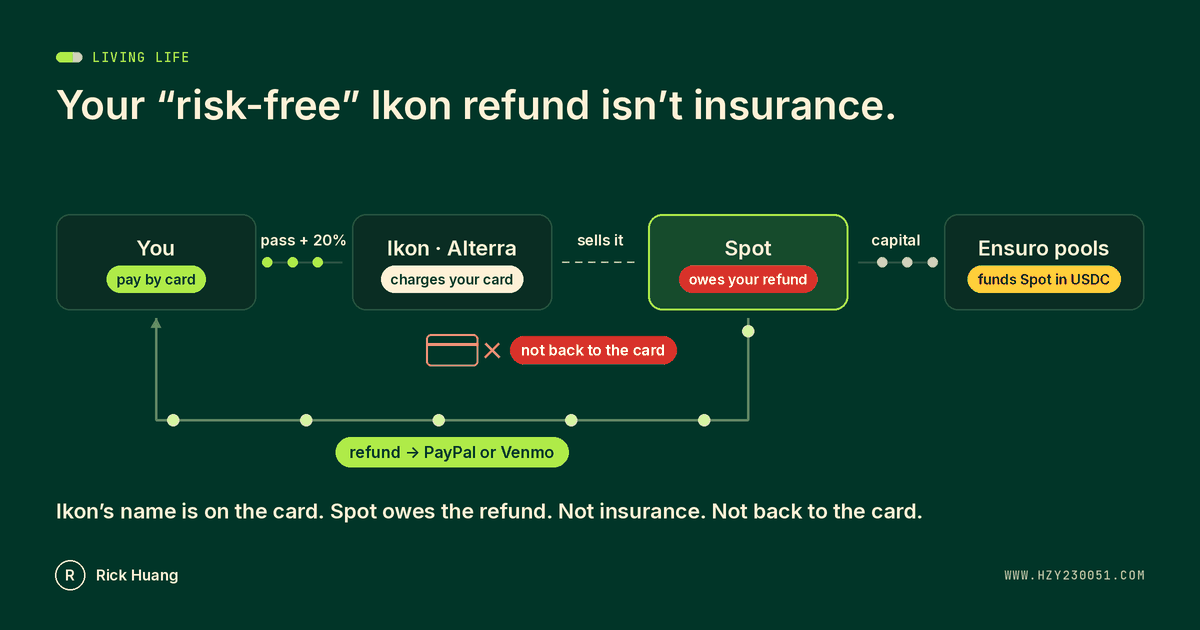
Four Companies, One Refund, One Name on Your Card
Ikon’s name is on your card. Ikon isn’t the one paying you back.
- Youpay by card
- Ikon · Alterracharges your card
- Spotowes your refund
- Ensurofunds Spot in USDC
Spot’s Ikon terms call it Alterra’s refund provider. You log in to Spot, not Ikon. Ensuro is a Bermuda-licensed crypto reinsurer that funds Spot’s refund products with USDC, a crypto token pegged to the US dollar, from crypto investors.
It’s Not Insurance. Spot Says So in Writing.
Spot’s terms file refunds under “non-insurance financial protection products.” Its refund terms (taken down by Spot; offline as of October 26, 2026) were blunt: not insurance, and Spot is not an insurance company.
What that changes:
- Insurance: reserves, solvency checks, claims laws, a state guaranty fund.
- Spot’s refund: Spot’s balance sheet and its backers. If that runs dry, you’re a creditor.
Two lines in the Ikon terms to know:
- The 24-hour payout clock starts when Spot confirms.
- Spot can delay or deny anything it sees as “unfair advantage.”
A $1.4 Million Crypto Pool That’s 99% One Company
Ensuro splits investor money into a senior pool, the safer slice that takes losses last, and a junior pool that takes them first. It sells the senior pool as diversified and low-risk.
“Diversified” pool. 99.4% one company.
Spot’s share of Ensuro’s senior pool
- $1.31Msenior pool · 88.6% locked
- $113KSpot-only junior pool · 82.9% locked
- $1,619one refundable Ikon Pass
~1,050 full refunds = every dollar in both pools.
Diversified. Sure. About $1.4M across both pools, close to 90% already locked, paying investors around 20% a year. Nobody earns 20% on something safe.
Fair warning: nothing public proves Ikon refunds sit in these pools. That’s the problem. From outside, nobody can tell who’s on the hook.
Twenty-Something Employees. Mostly Bosses. About Five Builders.
Spot’s public LinkedIn page shows twenty-something employees, mostly Director, Head of, or C-suite. By title, maybe five people build the product. Three CEOs in about two years.
Five people covering every edge case, every fraud vector and a refund stampede is a brutal job. I’d struggle too. Remember that org chart. It comes back in the code.
The Loophole: Card In, Venmo Out
This year, card purchases could be refunded to PayPal or Venmo. People noticed fast.
A wallet refund never shows up as a return on the card. As far as I can tell, it’s legal: the terms say “your account,” not which one. But it pulls in the buyers most likely to refund. Insurers call that adverse selection. One AI red-team prompt (“how would customers game this?”) surfaces it in a minute.
One catch: Ikon bans holding two passes of the same type in one season.
Open DevTools and See If They Called You a Fraud
Spot’s portal sends your browser the raw record behind every screen, including whether your refund was labeled fraud. You can read yours in a couple of minutes, no coding needed:
- Log in to the refund portal on a laptop.
- Open DevTools (F12, or Cmd+Option+I on a Mac) and pick Network.
- Click Fetch/XHR, type
certificatesin the filter, and reload. - Click the request. Preview shows the JSON folded up: click each ▸ to unfold a pass. Response shows the raw text.
- Look for
fraudFlagReasonsandresolutionStatus.
Some people now get a 401 “unauthorized” error instead: the portal stopped showing the record. The door may be closing.
Ask for your refund. Get a “fraud” flag.
“Fraud” here is a field name, not a finding
resolutionStatus"SPOT_CLAIM_COMPLETE""MANUAL_REVIEW"Paid, or waiting for a human.resolutionHandling"PARTNER_DEFERRED""PARTNER_24H_RULE"Who pays. “Partner” means Ikon.resolutionHandlingNote"Partner responsible for payout.""Claim denied for fraudulent activity"The reason you see.fraudFlagReasons"HIGH_REFUND_AMOUNT""HIGH_POTENTIAL_PAYOUTS""ACCOUNT_PREVIOUSLY_FLAGGED"Automated rules, filed under “fraud.”potentialPayoutReviewLimit200$200. Every Ikon Pass is above it.usageCount · blockRefunds0falseScans so far. Refunds switched off?ensuroStatus"CreationFailure"Did an Ensuro policy get created?carrier.certificateNumbernullNo insurance certificate. It isn’t insurance.
Show a sample record, unfolded
{
  "resolutionStatus": "MANUAL_REVIEW",
  "resolutionHandling": "PARTNER_24H_RULE",
  "resolutionHandlingNote": "Claim denied for fraudulent activity",
  "fraudFlagReasons": [
    "HIGH_REFUND_AMOUNT",
    "HIGH_POTENTIAL_PAYOUTS",
    "ACCOUNT_PREVIOUSLY_FLAGGED"
  ],
  "potentialPayoutReviewLimit": 200,
  "usageCount": 0,
  "blockRefunds": false,
  "ensuroStatus": "CreationFailure",
  "carrier": { "certificateNumber": null }
}
A composite of fields and values customers reported from their own accounts, not one real record. Other records showed SPOT_CLAIM_COMPLETE and PARTNER_DEFERRED.
I Gave an AI Their Refund Record. Here’s the Code Review.
Spot’s source code isn’t public. The record it sends your browser is. I handed those fields to an AI and asked for a code review. Three findings matter to every customer:
- The fraud rule fires on everyone. It flags any refund over $200. The cheapest refundable pass is $1,349.
- Labels that accuse. One reported reason: “Fraud confirmed - tried to log in before they got confirmation email.” That’s a timing glitch: the system checked before the email arrived. It isn’t fraud.
- Verdicts on open cases. Some records say “denied for fraudulent activity” while still waiting for a person to review them.
The full review, with severity ratings and the code these fields imply, is at the end for engineers.
Verdict: not great. This isn’t a subtle bug. It’s a review that never happened.
And in 2026, either way it’s an AI story:
- If AI wrote this code, nobody built the harness. No evals, no review gate, nobody asking what a threshold actually flags.
- If people wrote it by hand, old school, look back at that org chart. A weak general wears out his whole army.
Either way, even a basic AI code review catches a $200 threshold on a $1,349 product. That’s how I got the list above.
Spot is allowed to dislike how some people use its product. Close the loophole, cap passes, ban the gamers. Fine. Support blamed the delays on “fraud cases.” But don’t call customers fraudsters because a $200 rule fired. My family refund is textbook use. If that’s “fraud,” no refund speed buys the goodwill back.
One Bad Winter and the Math Breaks
Pay 20% extra, get up to 100% back. One full refund in five wipes out the 20%. You don’t even need AI for this one.
Ikon doesn’t publish numbers. A 2026 antitrust complaint estimated about a million pass products a year. Assume one in ten eligible buyers went refundable:
One refund in five wipes out the 20%. After that, it’s a hole.
Net, $M. 700K eligible passes, 10% go refundable, $1,150 average: $80.5M promised.
About $80M of promises in my scenario. $1.4M in the visible pool. You do the math.
Then add a terrible last winter, a strong El Niño, and a deadline that lands after December’s snow report.
Is Any of This Illegal? Not That I Can Find. That’s the Scary Part.
Three rulebooks: the insurance association (NAIC), the regulators, and the OCC. I’m not a lawyer.
Illegal? Not that I can find. That’s the scary part.
Public rules vs. public documents, Oct 2026. Not legal advice.
- No issue found
- Gray area
- Worth watching
- Does not apply
Insurance association (NAIC)
Model laws; they bind only where a state adopts them.
- Producer licensingNo issue found
Spot’s agency is licensed (NPN 18724703).
The waiver carve-out is for the travel supplier. Spot is a third party.
- Travel Insurance Model Act #632: opt-out banWorth watching
Checkout reportedly tested “refundable” as the default.
- Unfair Claims Settlement Practices Act #900Does not apply. That’s the problem
Prompt, fair claims rules cover insurance only. This isn’t insurance.
Regulators
States, consumer protection, Bermuda, card networks.
- State insurance departmentsGray area
A refund the buyer triggers likely isn’t insurance. No violation, no protection.
- FTC Act §5, MA 93A, Colorado CPA, Texas DTPAWorth watching
“Risk-free” next to “we may delay or deny.”
- Bermuda Monetary Authority (Ensuro)Worth watching
A “diversified” pool that’s 95%+ one partner, open to individual investors.
- Card network refund rulesGray area
No card credit at all. Outside the rails, not a clear breach.
Office of the Comptroller of the Currency
Banks, thrifts and, under the GENIUS Act, stablecoin issuers.
- OCC supervisionDoes not apply
Alterra, Spot and Ensuro aren’t banks.
- The stablecoin layerDoes not apply
USDC moves under the OCC by January 2027. The refund promise doesn’t.
- NAIC: Spot’s agency is licensed. The refund falls between the model laws, and the claims-handling act covers insurance only.
- Regulators: Probably no insurance violation, and no insurance protection. The live risk is consumer-protection law: “risk-free” next to slow or denied refunds.
- OCC: Doesn’t apply. Alterra, Spot and Ensuro aren’t banks. Only the USDC is moving under the OCC. The promise isn’t.
No broken law. That isn’t reassuring. It means a “risk-free” product lives in the gap between insurance law and everything else.
Yes, You Can Sue. Alone. In Denver or Austin.
- Ikon: no class actions, no jury. Denver, Colorado law.
- Spot: Austin, Texas law, Spot can choose arbitration, one year to file.
Easier routes: a card dispute, your state attorney general, the FTC.
Five Things to Watch Before January 15
- Ensuro’s pools: utilization near 100%, or a falling balance.
- Ikon’s terms page: quiet edits on refunds or “abuse.”
- Late refunds: one is a queue; a pile is a problem.
- Alterra: I’d expect it to step in before its brand takes the hit.
- December snow: the real refund rate.
“Risk-free” means the risk went somewhere. This season it landed on a small team in Austin, a portal that reaches for “fraud,” and, backing them in part, $1.4M of stablecoins in Bermuda.
In 2026, a $200 threshold on a $1,349 pass isn’t a headcount problem. It’s a choice not to look.
Ski hard. Read the terms. Check your certificates.
For Engineers: The Full Code Review
One AI pass over the reported fields:
- Critical Risk rules shipped to the browser. Flags, thresholds and backing status sit in a customer-facing response. Abusers learn which levers to avoid. Honest customers learn they’re suspects.
- High A threshold below the cheapest product. $200 against a $1,349+ pass flags every refund, so the flag tells you nothing.
- High Labels that accuse. “Fraud confirmed - tried to log in before they got confirmation email.” That’s a race condition, not fraud.
- High Impossible states. “Denied for fraudulent activity” on a record still in
MANUAL_REVIEW. A final verdict on an open case. - Medium: flags that never expire.
ACCOUNT_PREVIOUSLY_FLAGGED, with no decay and no appeal. Flagged once, suspect forever. - Medium: a 24-hour trap door. First-day refunds get
PARTNER_24H_RULEand bounce to Ikon. Some were marked fraudulent. - Medium: silent backing failures.
ensuroStatus: "CreationFailure". If the backing policy never got created, what backs that refund? - Low: a typo in an accusation. The screen read “Witholding payout due to suspected fraud.”
- Process: locking the door after the fact. A 401 hides the fields. It doesn’t fix the rules.
Show the logic these fields imply, and the fix
// My reconstruction from the reported fields. Not Spot's source.
const REVIEW_LIMIT = 200; // USD. Cheapest refundable Ikon pass: $1,349+

function screen(refund, account) {
  const fraudFlagReasons = [];
  if (refund.amount > REVIEW_LIMIT) fraudFlagReasons.push('HIGH_REFUND_AMOUNT'); // fires every time
  if (account.flaggedBefore) fraudFlagReasons.push('ACCOUNT_PREVIOUSLY_FLAGGED'); // never decays
  if (account.loginBeforeEmailConfirmed) refund.note = 'Fraud confirmed'; // a race, not fraud
  return { ...refund, fraudFlagReasons, potentialPayoutReviewLimit: REVIEW_LIMIT }; // sent to the browser
}

// What any reviewer would ask for instead
function screenFixed(refund, account) {
  const limit = percentile(refundAmounts(refund.product), 0.95); // scale to the product
  const riskSignals = scoreServerSide(refund, account, limit);    // keep it internal, call it risk
  queueForReviewIf(riskSignals.high, refund);                     // a human decides what's fraud
  return { status: customerStatus(refund.state) };                // customers get a status, not a verdict
}
Sources
Update, October 26, 2026: four of the pages below have been taken down by the companies that published them. Each is marked.
- Ikon Pass: FAQ, Purchase Terms & Conditions, 2026/27 launch post
- Spot: Ikon Refund Guarantee terms, Refund Guarantee terms (taken down by Spot, offline as of Oct 26, 2026), Terms of Service, Ikon partnership announcement (taken down by Spot, offline as of Oct 26, 2026)
- Ensuro: licensing history, how the pools work (archived copy from May 12, 2026; Ensuro took the original down, offline as of Oct 26, 2026), contract deployments (taken down by Ensuro, offline as of Oct 26, 2026), senior pool, DefiLlama
- Pricing and market: SKI on refundable pricing, PeakRankings on the 2026/27 passes, antitrust complaint coverage, OpenSnow winter outlook
- Rules: NAIC Travel Insurance Model Act, NAIC Unfair Claims Settlement Practices Act, New York’s definition of insurance, FTC Act, OCC: who we are, GENIUS Act summary
Nothing here is legal or financial advice. If your refund is late, keep screenshots of the terms and every email.
Found this interesting? Share